

Gokarna: A Sacred Town Where Life and Death Share the Same Silence
To visit Gokarna only for the beaches is to see the skin of the place but miss its beating heart. The true pilgrimage here is not to the ocean, but to the Atma Linga, and to the understanding of mortality itself, to the many shrines around each of which has its own story. This is a land where the divine does not just visit; it resides, anchored by a history that stretches back to the dawn of treta yuga.
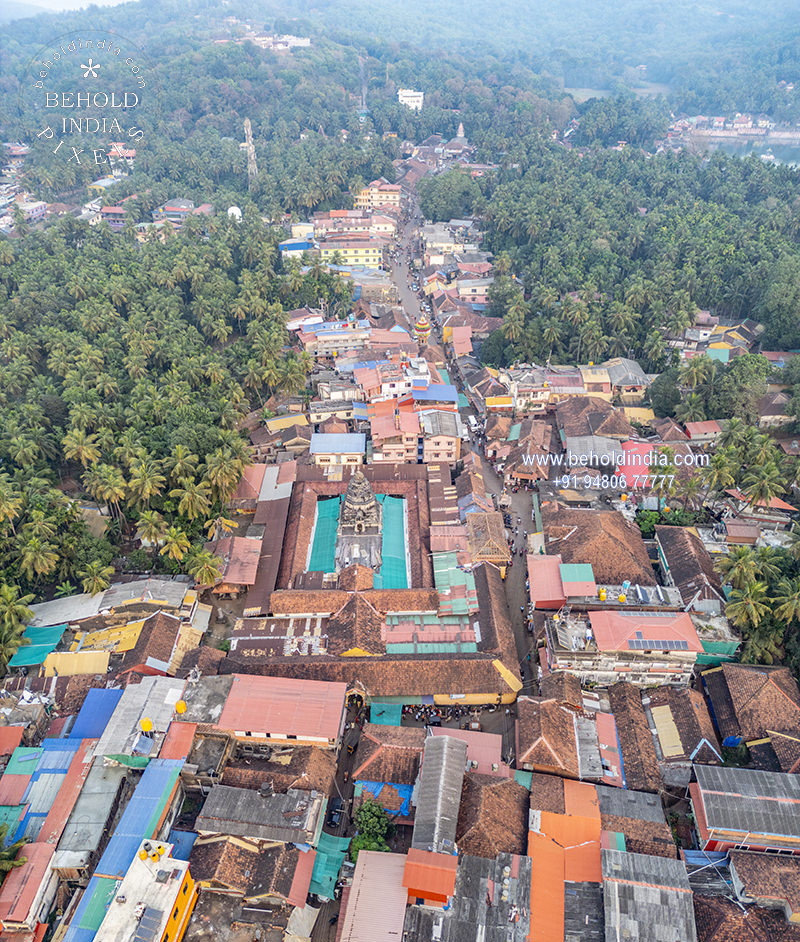
If you stand still enough in the narrow, cattle-crowded lanes of Gokarna’s main street, you can hear a sound that predates the invention of the camera, the stereos, and perhaps even the written word. It is not the crash of the waves at Om Beach, nor the music beats drifting from the numerous beachside restaurants. It is a low, rhythmic hum…the collective vibration of Vedic chanting that seems to seep out of the very laterite stones of the town.
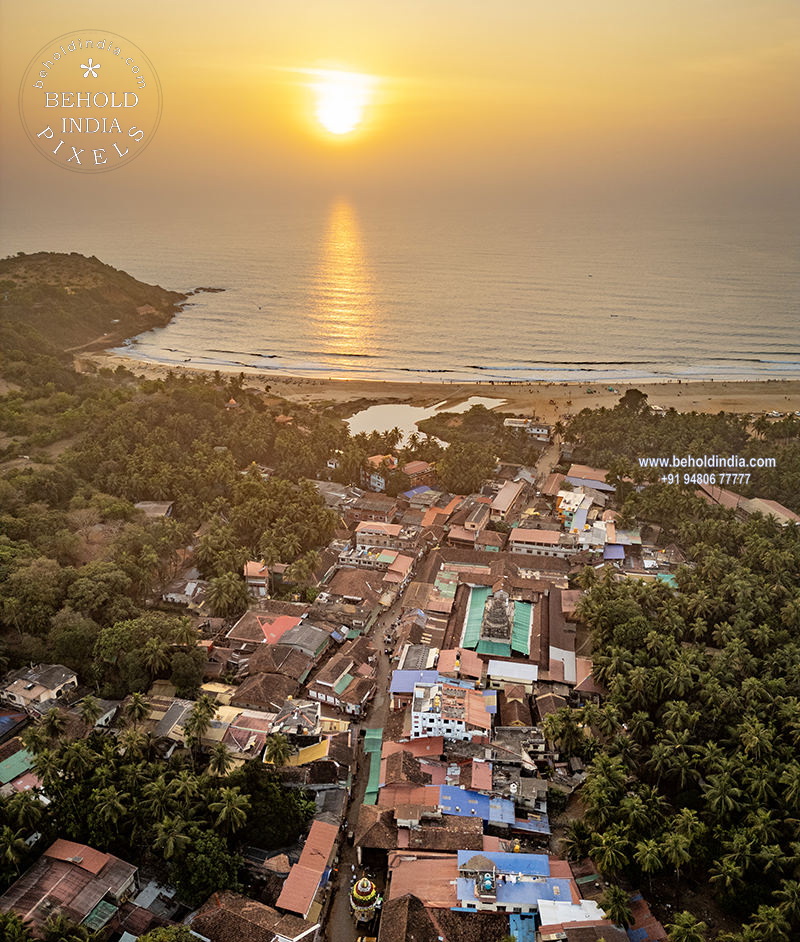
While the world knows Gokarna for its rough & raw coastlines and backpacker life, there is a deeper reality to this town, a solemnity of manner that feels heavy in the humid air. This is Dakshina Kashi, the Varanasi of the South… a place where the veil between the corporeal world and the ethereal plane is precariously thin.
Anchored by the immovable Atma Linga, Gokarna is where cosmic history breathes through ancient laterite, silencing the modern world’s fleeting noise.
The Physics of Divinity: The Itihasa of the Atma Linga
To understand the architecture of Gokarna, one must first understand the weight of the history that stood on the earth here. This is not folklore; it is Itihasa….which truly happened—recorded in the Shiva Purana (Kotirudra Samhita) and the Skanda Purana.
The account begins with Ravana, the King of Lanka. Ravana while in most part was the villain of the Ramayana; he was a devout Shaiva, a great warrior, a master of the Vedas, and a musician of unparalleled skill. His Tapasya on Mount Kailash was so intense that Lord Shiva, pleased by his devotee’s ferocity of devotion, granted him the Atma Linga, his very essence, and the very soul of the cosmos, also known as the Prana Linga. Possession of this would make Ravana immortal and invincible, upsetting the cosmic balance.
The condition set by Shiva was absolute: the Linga must never touch the ground before reaching Lanka. If it did, it would remain fixed there forever, its weight becoming equal to the universe itself.
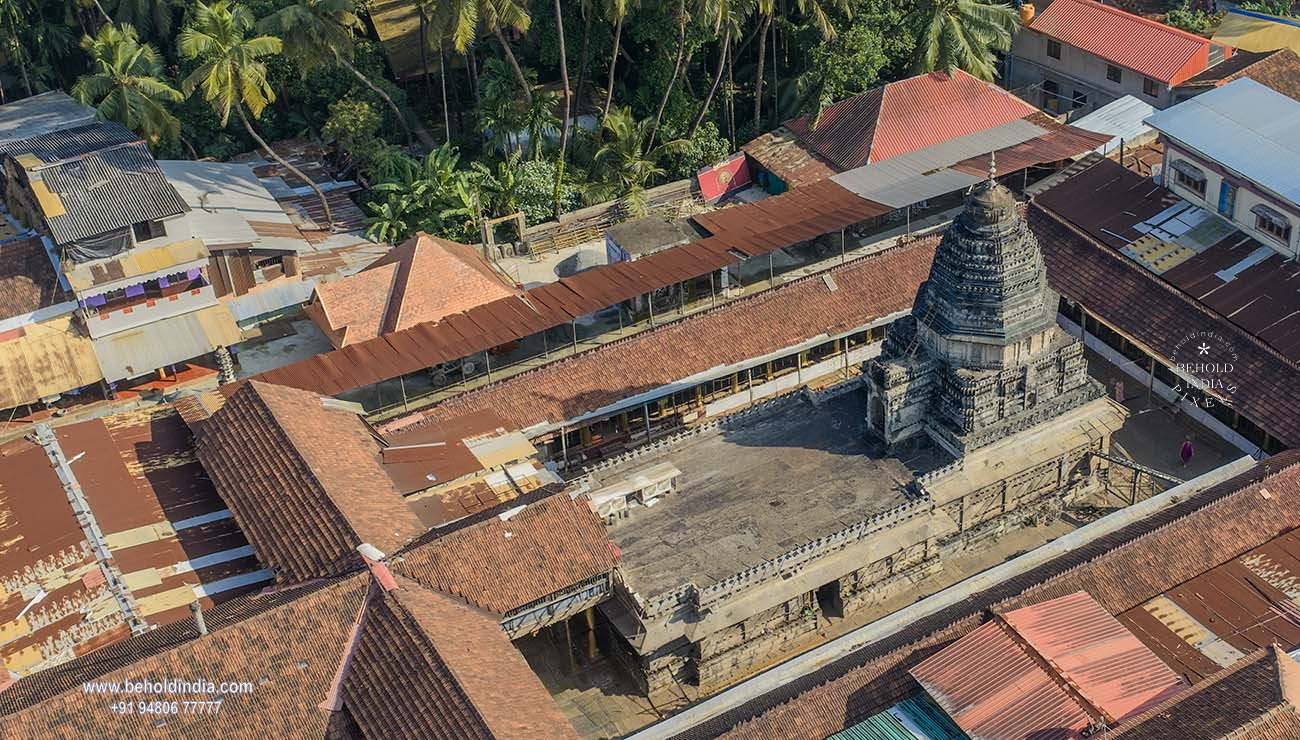
The Gokarna Mahatmya details the subsequent divine intervention. The Devas, fearing Ravana’s impending invincibility, sought the help of Lord Ganesha and Lord Vishnu. As Ravana approached the western coast, Indra darkened the sky, creating the illusion of dusk. Ravana, a devout person by practice, needed to perform his evening Sandhyavandana rituals. He found a young cowherd boy (Ganesha in disguise) and asked him to hold the Linga, instructing him never to set it down.
Ganesha agreed but with a caveat: he would call Ravana’s name three times if the weight became too much. As Ravana immersed himself in water, Ganesha rapidly called out three times and placed the Linga on the earth before Ravana could return. The illusion of dusk lifted, the sun reappeared, and Ravana realized he had been tricked.
Enraged, he tried to uproot the Linga. He pulled with the strength of twenty arms, twisting the stone, distorting its shape, and flinging fragments across …creating the secondary Kshetras at Murdeshwar, Dhareshwar, Gunavanteshwar, and Shejjeshwar. But the root at Gokarna held. The Linga stayed. The Puranic history states, Shiva emerged from the ear of the earth-mother cow (Prithvi) to witness this event.
This is why the energy here feels ancient and immovable. You are not walking on a tourist trail; you are walking on the grounds of a cosmic event documented in the scriptures.
The Historical Record: The Keladi Inscription
While the Puranas provide the spiritual foundation, the human history of Gokarna is equally compelling and verified by archaeology. The sanctity of this site has drawn the patronage of empires for nearly two millennia.
A critical piece of historical evidence anchors the temple’s timeline: a stone inscription discovered from the period of the Keladi Empire. This epigraph explicitly states that the Mahabaleswara Temple underwent a significant renovation under the reign of Mayuravarma, the formidable founder of the Kadamba dynasty (c. 345 CE).
Mayuravarma is a titan in Karnataka’s history—a Brahmin scholar turned warrior-king who established the first native Kannada empire. That he prioritized the renovation of this temple indicates that by the 4th century CE, Gokarna was already an established, ancient center of power. It was not merely a place of worship but a legitimizing force for kingship. When you touch the pillars of these temples, you are touching stone that was likely consecrated under the orders of the Kadambas, and later protected by the Vijayanagara emperors and the Keladi Nayakas.
The attribution of the temple’s renovation and consecration to Mayuravarma (c. 345 CE), the founder of the Kadamba dynasty, is a well-established historical fact supported by multiple sources.
Mayuravarma’s Role: Historical records affirm that Mayuravarma invited learned Brahmins (often cited from Ahichhatra) to settle in this region, solidifying Gokarna as a center of Vedic learning.
The Keladi Connection (17th Century)
The Keladi Nayaka dynasty (who ruled much later, 16th–18th century) are the primary architects of the temple’s current structure.
Documented Renovations: Historical records confirm that during the reign of Queen Chennammaji and her son Soma Sekharanayaka (17th Century), significant additions were made. specifically, the Chandrasala and Nandi Pavilions were constructed by Visvesvaraya of Halasunadu-Kundapura under Keladi patronage.
The Inscription: The specific detail regarding a “Keladi inscription stating Mayuravarma renovated the temple” is a reference to a Danashasana (grant inscription) where a later King (Keladi) invokes the name of the earlier consecrator (Mayuravarma) to establish lineage or continuity of Dharma. This is a common practice in Indian epigraphy—later kings would repair a temple and leave an inscription saying, “I, King X, renovated this temple originally built by the great King Y.”
The Circumambulation: A Walk Through Stone and Scripture
The pilgrimage protocol in Gokarna is strict, a spiritual algorithm documented in the local Sthala Puranas designed to prepare the human nervous system for the energy of the main shrine. It begins, inevitably, with the Shree Mahaganapati Temple.
Located just a stone’s throw from the main temple, this shrine houses the standing idol of Ganesha—the boy who intercepted Ravana. The form here is unique; it is Dwibhuja (two-armed), standing, and bereft of the usual rotund cheerfulness of modern Ganesha depictions. There is a dent on the head of the deity, recorded in the texts as the mark where an enraged Ravana struck the boy with his knuckles. The sanctum is small, dark, and smells intensely of crushed hibiscus and camphor. You must offer your obeisance here first; to bypass the gatekeeper is to render the rest of the pilgrimage void.
From there, the gravity of the town pulls you toward the Mahabaleswara Temple. This is the epicenter. The temple structure is a masterpiece of Dravidian architecture, built from granite that seems to absorb the heat of the day and the prayers of the centuries.
Inside, the Atma Linga is not an imposing black pillar as seen in other Shiva temples. It is underground, encased in a square Saligrama Peetha. Pilgrims can only touch the depression in the stone, the very top of the Linga that Ravana tried to twist. The vibration in this inner sanctum is palpable. It is a silence that screams. In the flickering oil lamps, you see faces from every corner of India—eyes closed, hands trembling, touching the stone that anchors the universe. The rituals here are visceral; the Abhishekam (ritual bathing of the deity) is performed with a devotion that feels urgent, a plea for grace in a transient world.
The Waters of Absolution: Koti Teertha
If the Mahabaleswara temple is the fire of Gokarna, the Koti Teertha is its water. This man-made tank, spanning over seven acres, is surrounded by laterite steps and a perimeter of smaller shrines and mutts. The water is green, opaque, and teeming with life.
The Skanda Purana mentions that a crore (koti) of holy springs converge here. This is not a swimming pool; it is a ritual engine. This is the stage for the Pitru Karya—the ancestral rites. In the Vedic tradition, our existence is a debt owed to our ancestors (Pitru Rina). Gokarna is one of the few places on earth, alongside Varanasi and Gaya, where this debt can be fully repaid.
You will see families sitting in wet clothes on the stone steps, guided by priests in white robes. They offer balls of rice (pinda) to the crows, chanting the names of fathers, grandfathers, and great-grandfathers. They are feeding their lineage, severing the karmic chords that bind the living to the dead, and praying for the Moksha (liberation) of departed souls. The atmosphere is solemn, yet strangely light. There is a sense of release here, a feeling that burdens carried for generations are being washed away in the green waters.
The Final Offering
Gokarna is not a destination for a checklist. It is a mood. It is the scent of wet stone, burning camphor, and salt air. People come here to bury the past—literally, in the ashes of the cremation ground, and metaphorically, in the waters of the Koti Teertha. They come to touch the Atma Linga and remind themselves that while the body is fragile as a clay pot, the spirit (Atman) is as stubborn as the stone that Ravana could not lift.
When you leave Gokarna, do not just take photos of the sunset. Take with you the silence of the temples and the realization that you have walked on ground that has been sanctified by the Devas themselves. In a world of constant noise and fleeting digital distractions, Gokarna offers the most terrifying and beautiful thing of all: the unvarnished truth of who you are, and where you are going….essentially of life…and death …
Related Posts
Yana: Where the Earth Breathes in Silence
Hidden deep within the emerald folds of the Western Ghats, Yana feels like a secret whispered by the forest itself. About 25 kilometers from Kumta and roughly 40/50 kilometers from Gokarna (dependent on the route), this quiet village in Karnataka shelters extraordinary rock formations
